
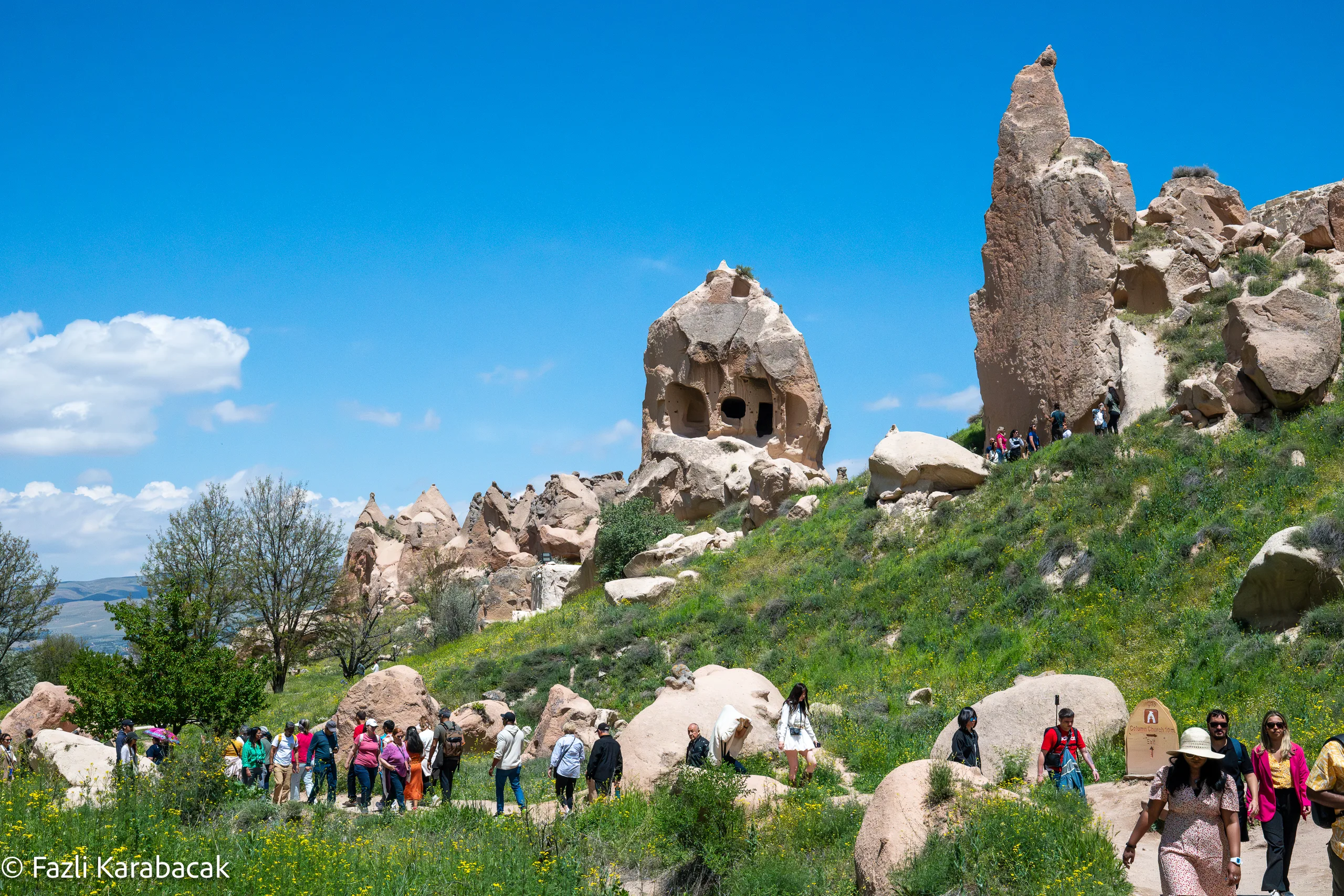
What is Zelve Open Air Museum?
Zelve Open Air Museum is a complex of three interconnected valleys where people lived continuously from the early Christian era until 1952. Unlike the nearby Göreme Open Air Museum, which is primarily a monastic complex, Zelve was a living, working village — complete with homes, churches, a mosque, grain stores, kitchens, and even a small vineyard carved into the volcanic tuff.
When erosion and rockfalls made the valley unsafe in the early 1950s, the Turkish government relocated the entire population to the newly built village of Yeni Zelve (New Zelve), just a few kilometres away. What remains is a haunting ghost village frozen in time — one of the most atmospheric places in Cappadocia to explore.
The Three Valleys
Zelve is divided into three valleys (Valley 1, 2, and 3), each with a distinct character. Valley 1 is the most accessible and contains the majority of the cave dwellings, a rock-cut church with remnants of painted decoration, and the remarkable rock-cut mosque — one of the only examples in the region of an Islamic place of worship carved from the stone rather than built.
Valley 2 is narrower and more dramatic, with towering fairy chimneys and multi-storey cave formations that show how entire families lived vertically inside the rock. You can still see the carved niches for storage, the blackened ceilings from cooking fires, and the pigeon holes used for fertiliser collection.
Valley 3 is the most remote and wild. The path narrows and the formations become increasingly surreal — twisted pillars of rock, collapsed tunnels, and precarious overhangs that explain why the village had to be abandoned. This valley gives the strongest sense of how the landscape is still actively eroding and reshaping itself.
The Rock-Cut Mosque
One of Zelve's most remarkable features is the rock-cut mosque in Valley 1. While Cappadocia is famous for its Byzantine cave churches, this is a rare example of an Ottoman-era mosque carved directly into the tuff. The interior features a simple mihrab (prayer niche) oriented toward Mecca, and the space retains a serene, contemplative atmosphere. The mosque is evidence that the cave-dwelling tradition continued well after the region's Christian era.
Fairy Chimney Forest
The area surrounding Zelve contains one of Cappadocia's densest concentrations of fairy chimneys. These extraordinary geological formations — tall pillars of soft tuff capped by harder basalt lids — are formed over millions of years as wind and rain erode the softer rock beneath the protective cap. Walking through the fairy chimney forest near the museum entrance gives you an up-close encounter with these formations, many of which still bear the carved-out rooms and dovecotes of their former inhabitants.
Paşabağ (Monks Valley)
Just 1km from the Zelve entrance, Paşabağ — also known as Monks Valley — is home to the famous "three-headed" mushroom fairy chimneys, among the most photographed formations in all of Cappadocia. These multi-capped pillars are geological rarities formed when the erosion process splits a single capstone into multiple sections, creating a surreal mushroom-like silhouette.
Paşabağ also contains a hermit monk's chapel carved high into one of the taller chimneys, accessible by a narrow carved staircase. The valley is small enough to explore in 20–30 minutes and is often combined with a Zelve visit on the same ticket or itinerary.
Zelve vs. Göreme: Which Should You Visit?
Göreme Open Air Museum is the more famous site, with its well-preserved Byzantine frescoes and UNESCO status. Zelve, by contrast, has far fewer preserved paintings but offers something Göreme cannot: the feeling of exploring a real village. You can wander freely through domestic spaces, climb between levels, and peer into rooms that were lived in within living memory.
For a complete understanding of Cappadocia's cave heritage, both are worth visiting. Many of our guests say Zelve was their unexpected favourite — quieter, more adventurous, and far more atmospheric than they expected.
Practical Information
Zelve Open Air Museum is open daily from 8:00am to 7:00pm in summer and 8:00am to 5:00pm in winter. The entrance ticket also covers Paşabağ (Monks Valley). The Museum Card is accepted. The site involves uneven ground, steep paths, and some scrambling — wear sturdy shoes and bring water.
Best time to visit: Early morning or late afternoon. The soft light brings out the warm colours of the tuff and the valleys are quieter outside peak hours. Allow at least 1.5 to 2 hours to explore all three valleys properly.
Getting there: Zelve is located about 10km from Göreme centre, off the Avanos road. It is included on most Red Tour itineraries and is an easy stop when driving between Göreme and Avanos.
Visit Zelve with an Expert Guide
Zelve's story goes far beyond what the signboards explain. A knowledgeable guide brings the abandoned village to life — explaining who lived where, how they cooked and stored food inside the rock, why the mosque was carved in this location, and how the 1952 evacuation unfolded. Our guides know the hidden chambers and photogenic angles that most visitors walk past.