
Quick Answer
Hot air balloons in Cappadocia launch around 5am, fly for 45–75 minutes, reach altitudes of 300–900 metres, and cost 120–200 USD per person in 2026. On a busy morning, you’ll share the sky with 20–25 other balloons (the regulated maximum). Always book with CAA-licensed operators (check SHGM certification) — unlicensed companies charge less but expose you to serious liability. The experience is genuinely worth it if you go with a reputable company, have realistic expectations about comfort, and accept that weather cancellations happen even in peak season. We’ve been running balloon tours for over 25 years — here’s exactly what you’re paying for and how to avoid the pitfalls.
How Cappadocia Hot Air Balloon Flights Work: The Logistics
You’ll hear a lot of romantic language about floating silently over fairy chimneys at sunrise. That part is true — but the real story starts hours before dawn.
The Schedule: 5am Launch (or Earlier)
We pick you up from your hotel between 4am and 4:30am. The timing depends on sunrise, which shifts with the season. In summer (late June), sunrise hits around 5:30am, so launches happen closer to 5:30am. In winter, sunrise is 7:30am, and launches move to 6:30am or later.
You’ll feel tired. Everyone does. Bring coffee, water, and manage expectations — the magic happens despite the early wake-up, not because of it.
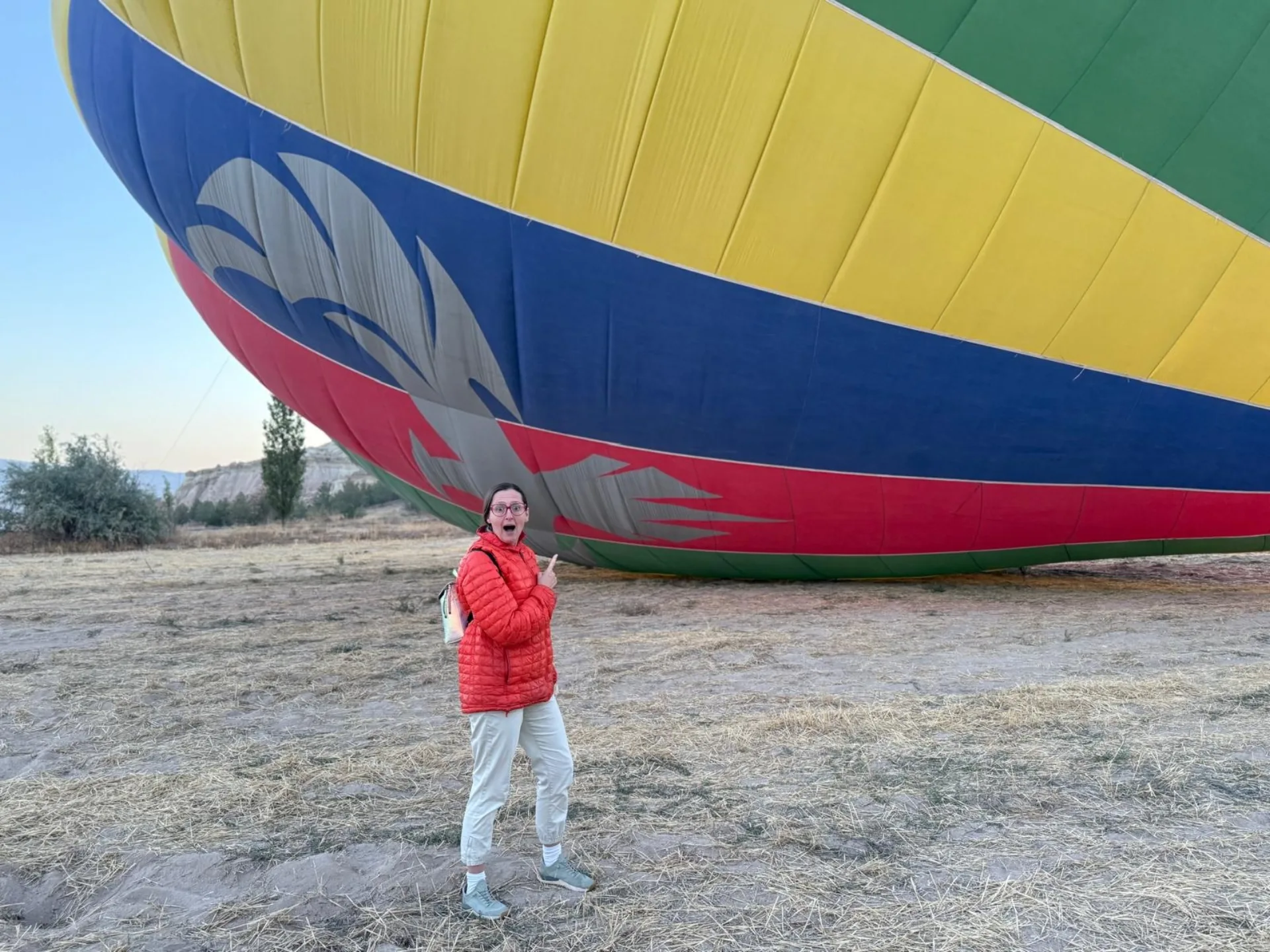
You’ll arrive at the launch field (there are several around Göreme) where 8–12 balloons are being inflated. Each balloon has a crew of 3–4 ground handlers working in the darkness with torches and handheld radios. The envelope (that’s the balloon part) is about 24 metres tall — taller than a seven-story building. Watching it fill with cold air from the burner is genuinely spectacular.
What Happens During Flight
Once airborne (takes about 10 minutes), the balloon rises to around 300–400 metres within the first 15 minutes. The ground noise disappears. You can hear voices from other balloons, wind in the rigging, and the occasional roar of the burner as your pilot adjusts altitude.
We stay aloft for 45–75 minutes depending on wind patterns. Most flights run 60 minutes, but that’s variable. Your pilot is constantly reading the wind at different altitudes — looking for the layer that’s moving toward the best scenery. Some mornings, the best light happens at 500 metres. Other times, the pilot will edge higher (up to 900 metres, sometimes 1,000 metres if conditions allow) to get above clouds or catch better wind.
You’ll pass over the Rose Valley, Needle Valley, and depending on wind direction, Pasabag or the area around Ürgüp. The pilot has no control over lateral movement — he’s drifting with the wind — so each flight draws a different path. That’s why professional pilots earn that reputation: they’re constantly adjusting altitude to catch the wind layer that flows over the best scenery.
The Landing and Recovery
The pilot radios the ground crew to track your drift and position a pickup point. You’ll descend toward a large, open field (never buildings, never rocky terrain — these crews know their job). The landing feels like a gentle bump — some days you’ll barely notice it. Other days, if there’s a stiff breeze at ground level, it can feel firmer. Hold the handles.
Once down, the crew deflates the balloon, packs the envelope, and loads everything into a truck. This takes about 15 minutes.
You return to your hotel by 8am–8:30am, and breakfast is waiting.
What to Expect: The Reality Check
I’m going to be honest, because I’ve heard too many guests say afterward, “I expected it to feel more magical.”
The Basket is Cramped
A typical balloon basket holds 16–20 passengers (depending on the company and balloon size). The basket is woven wicker, about 1.5 metres on each side. You’re standing — not sitting — pressed against strangers, usually shoulder to shoulder. Pregnant women, people with back problems, anyone over 100kg, and anyone prone to claustrophobia should think carefully. We have smaller baskets (8–12 passengers) available through some operators, but they cost more.
You Can’t See Straight Down
This surprises people. The basket wall comes up to your mid-chest. You can see down and to the sides, but if you want to photograph straight below, you’re leaning over the edge, and the rigging is in the way. Professional photographers either book smaller baskets or accept that they won’t get the Instagram shot they imagined.
It’s Cold and Windy
At 400–600 metres, the temperature drops 2–3°C for every 300 metres of altitude. In spring, you might launch at 15°C and climb into 5°C air. Wear layers. The wind makes it feel colder. Sunscreen and lip balm, too — the morning sun reflects hard off the light stone.
The Noise is Real
Between the burner roaring to heat the air and the wind noise, you can’t have a quiet conversation. You can hear nearby balloons and ground crews. It’s not silent meditation; it’s a sensory experience. Many guests find it energizing. Some find it stressful.
You’re Sharing the Sky with 20+ Other Balloons
On a busy morning, Cappadocia’s airspace holds 20–25 balloons simultaneously (the Turkish Civil Aviation Authority, SHGM, has strict caps on flight density). That sounds chaotic, but pilots are skilled at staying separated by altitude. You’ll see other balloons — sometimes quite close. If you want solitude, that’s not what you’re booking.
Weather Cancellations Happen Even in Peak Season
In April–June, expect a 5–10% cancellation rate due to wind or poor visibility. In autumn (September–October), maybe 10–15%. Winter jumps to 30–50%. If your flight gets cancelled, you reschedule. Most operators offer free rebooking, but you need flexibility.
Pricing in 2026: What You’re Actually Paying
Cappadocia balloon prices have stabilized around:
- Standard flight (16–20 passengers): 120–160 USD
- Premium flight (8–12 passengers, better baskets): 160–200 USD
- Private balloon (4–6 people, very rare): 250–400 USD total
These prices include pickup, flight, and usually a post-flight certificate and sometimes light refreshments.
Be wary of flights under 100 USD — they almost certainly come from unlicensed operators. More on that below.
What Affects Price
Seasonality matters. April–May and September–October (peak seasons) command the highest prices. July–August also run high (crowds), but you might find deals in early June or late August. January–February are cheapest.
Balloon size matters. Smaller baskets (fewer passengers) mean more comfort and better photography but higher per-person cost.
Pickup location matters. Hotels in central Göreme have shorter transfer times. If you’re staying in Avanos or Ortahisar, transfers are longer, and some operators charge extra.
Inclusions vary. Some operators include breakfast, some don’t. Some include professional photos; others charge extra. Read the fine print.
How to Choose a Company: Licensed vs. Unlicensed (The Safety Question)
This is where I need to be direct. Cappadocia has both licensed, professional balloon operators and unlicensed cowboys. The price difference can be 40–50 USD, which feels significant when you’re on vacation. But the risk difference is enormous.
Licensed Operators (SHGM Certified)
Turkey’s Civil Aviation Authority, the Sivil Havacılık Genel Müdürlüğü (SHGM), requires balloon operators to:
- Hold a commercial air transport license (CAT)
- Employ only pilots with 500+ hours of balloon flying experience and current medical certificates
- Conduct monthly balloon envelope inspections (heat, pressure, seam integrity)
- Carry comprehensive liability insurance (minimum 2 million Turkish Lira, roughly 60,000 USD)
- Maintain detailed flight logs and incident reporting
- Follow strict passenger weight limits and basket load calculations
- Comply with airspace density regulations (max 25 balloons per zone)
If something goes wrong — a landing injury, an accident, a dispute — your legal recourse is clear. The operator is bonded. Insurance covers you.
How to verify: Ask the operator for their SHGM certificate number or CAT license. Legitimate companies display this proudly. If they deflect or say “it’s too complicated to explain,” they’re not licensed. The SHGM website (shgm.gov.tr) publishes the list of licensed operators. Check it.
Unlicensed Operators
These are usually small family operations or tour agencies that partner with unlicensed pilots. They don’t hold CAT licenses, pilots may have limited experience, baskets may not be properly certified, and insurance is minimal or non-existent.
The pitch you’ll hear: “Same flight, half the price. The pilot is experienced. You’ll be fine.”
Maybe you will. But if the pilot makes a mistake, if the envelope fails, if there’s an accident — you have no recourse. Turkish law won’t cover you. Your travel insurance won’t cover you (they exclude unlicensed aviation). You could be liable for damages.
I’ve been doing this for 25+ years because it’s a real profession, not a side hustle. Our pilots have thousands of hours. Our balloons are maintained to standards. That costs money. We charge accordingly. You get what you pay for.
Best Time of Year for Balloon Flights
Different seasons present different conditions:
April – June: Peak Season, Reliable Flying
Spring offers the highest success rates. Clear skies, moderate temperatures, and stable wind patterns mean you’ll fly. Expect 85–95% flight confirmation rates. The downside: prices are highest, and popular operators book up. Reserve 2–3 weeks in advance.
The light in May is extraordinary — soft golden hour lasts until nearly 6:30am.
July – August: Hot but Consistent
Summer temperatures are brutal (30–35°C), but balloon flights are still reliable. The heat means earlier launches (sometimes 5:15am or even 5:00am) to get airborne before the ground warms. Cancellation rates remain low (5–10%).
Expect crowds and higher prices. Book 3–4 weeks ahead.
September – October: Excellent, Less Crowded
Autumn is our personal favourite for balloon flights. Temperatures are mild (18–25°C), cancellation rates are low (10–15%), and the lower sun angle creates dramatic shadows across the valleys. Fewer tourists mean smaller balloon baskets on some days.
Reserve 2–3 weeks in advance; the best operators fill up in September.
November – March: Gamble on Weather
Winter flying is unpredictable. Wind patterns become erratic, and cold temperatures can make envelope handling difficult. Cancellation rates in January–February can exceed 50%.
If you must fly in winter: Have flexibility in your schedule. Plan for 2–3 backup days. Winter offers lower prices and thinner crowds if you get lucky.
Cancellation Policies and Weather
Every operator should offer a clear cancellation policy:
Standard policy:
- If we cancel due to weather, you reschedule free for another day or get a full refund.
- If you cancel with 48+ hours notice, you get a refund.
- If you cancel with less than 48 hours notice, you forfeit the fee.
This is fair — the operator has already paid the pilot and crew and reserved airspace.
Weather decisions: Pilots make final calls 30–60 minutes before launch. Wind speed, visibility, cloud cover, and upper-wind forecasts are continuously monitored. If conditions are marginal, most operators will give you the choice: fly and accept higher risk, or reschedule.
My advice: If you hear “It’s marginal, but we’ll try,” ask yourself honestly: Am I okay with landing in gusty conditions? If the answer is no, reschedule. There will be another window.
Safety: Envelope, Pilot, Regulations
Hot air ballooning is statistically safer than driving to the airport. But let’s be clear-eyed about risks:
The Equipment
A balloon envelope is made of ripstop nylon (similar to parachute fabric) with load tapes running vertically. It’s washed and inspected monthly. Modern envelopes are built to last 500+ flying hours. Cappadocia’s operators cycle through balloons regularly — most are 5–10 years old, which is prime life.
Failure risk: Envelope failures (tears, structural failures) are rare — roughly 1 per 50,000 flights. When they happen, the balloon descends slowly and predictably. It’s not a sudden drop.
The Pilot
SHGM-licensed pilots in Cappadocia average 1,000–3,000 hours of experience. They train in various weather and wind conditions. They know Cappadocia’s airspace intimately.
Pilot error risk: The main risks are landing mistakes in gusty wind, poor wind-layer navigation, or decisions to fly in marginal conditions. Licensed operators have strict minimums that keep pilots from cutting corners. Unlicensed operations? That’s where judgment calls become dangerous.
The Regulations
SHGM enforces strict rules:
- Maximum 25 balloons per airspace zone
- Minimum 500-metre separation between balloons (pilots maintain this visually)
- No flights above 1,200 metres except with special clearance
- No flights in visibility below 1 kilometre
- No flights in sustained winds above 12 knots
These rules exist because people died in the past. Turkey learned. Now the regulations are tight.
Incident History
Cappadocia has had a few incidents over the decades, but serious accidents are rare (fewer than 5 in the past 20 years with licensed operators). Most incidents involve minor injuries (sprains, bruises) during rough landings — not envelope failures.
Compare this to rock climbing, whitewater rafting, or skiing, and ballooning is lower risk.
Photography Tips for Balloon Flights
You’re paying partly for the view. Here’s how to capture it:
Bring the Right Gear
- Phone camera is fine — iPhones and modern Android cameras handle low light (pre-dawn) reasonably well. Avoid using zoom (crops the image and magnifies camera shake).
- Mirrorless camera (ideal): Lightweight, fast autofocus, good low-light performance. Bring a lens around 24–70mm.
- DSLR: Works, but heavier. In a crowded basket, weight is a factor.
- Avoid: Tripods (no room), large telephoto lenses (rigging gets in the way), or anything that blocks your neighbors’ views.
Camera Settings for Dawn Light
The light at 5am–6:30am is dim. You need:
- ISO 1000–3200 (higher than you’d normally use)
- Shutter speed 1/500 second or faster (the basket shakes slightly)
- Aperture as wide as your lens allows (f/2.8 or f/4 is ideal)
- Auto white balance (the pre-dawn light is bluish; let the camera correct it in post if needed)
Shoot in RAW if your camera allows it — it gives you more flexibility in post-processing to recover shadow detail.
Composition Tips
- Shoot sideways and downward. The balloon envelope above blocks upward shots.
- Include neighboring balloons. They add context and scale to the scene.
- Capture the valleys, not just the sky. The real subject is the land below.
- Shoot sequences, not single shots. The light is changing fast. Take 10–20 frames in the first 10 minutes of flight.
- Include fellow passengers. The human element (faces, silhouettes, reactions) often makes the best photos.
The Horizon Problem
In a tilting, drifting basket, the horizon will be wonky. Straighten it in post-processing (Lightroom, Snapseed, or Adobe Capture). Don’t stress about it during the flight.
Video
Most smartphones shoot decent 1080p or 4K video now. Shoot landscape orientation (not portrait). Avoid panning too quickly — the basket movement becomes nauseating. Let the camera sit still and capture the landscape drifting.
Is It Really Worth It? The Honest Answer
After 25+ years of guiding, I’ll give you my honest assessment.
Absolutely worth it if:
- You have flexible expectations (comfort, crowds, perfect weather)
- You’re genuinely interested in Cappadocia’s landscape from a unique vantage point
- You can afford a licensed operator (120–160 USD minimum)
- You go in spring or autumn (best conditions, fewer reschedules)
- You have 2–3 backup days in case of cancellation
- You’re okay standing in a crowded basket for an hour
Maybe skip it if:
- You’re on a tight budget (wait for off-season or save for a private balloon)
- You’re afraid of heights (even at 400m, the height is real)
- Your knees or back won’t handle standing for 75 minutes
- You’re traveling in winter and need reliability
- You expect silence or solitude (there are 20+ balloons in the sky)
- You’re pregnant or weigh over 120kg (weight and safety limits apply)
The real value: It’s not actually about the balloon ride itself — it’s about seeing Cappadocia from above. The fairy chimneys, the valleys, the scale of the landscape — nothing compares to that view. The balloon is just the vehicle. That view is worth the cost and the early morning and the crowded basket.
I’ve been to the top of the best mountains in Cappadocia. I’ve hiked every valley. But seeing the landscape from a balloon is different. You understand the geography in a way that’s not possible from the ground.
So yes. Book with a licensed operator, expect discomfort, and go. You won’t regret it.
Frequently Asked Questions
What exactly is the weight limit for balloon flights?
Most Cappadocia balloon operators set a per-person limit of around 110–120kg, with a total basket weight limit of around 2,000kg. This isn’t vanity — it’s safety and physics. A heavier basket reduces how high the balloon can climb and affects landing characteristics. Some operators offer reinforced baskets or private balloons for heavier passengers. Always disclose your weight when booking; operators have seen everything and won’t judge.
Can I reschedule if the flight is cancelled for weather?
Yes. Every licensed operator allows free rescheduling if weather cancels the flight. You pick another day, or if you’re leaving soon, you get a full refund. Some offer a credit valid for one year. Check the specific policy before booking, but all reputable operators protect you here.
Will I get sick from the height or motion?
Unlikely. The balloon rises and drifts smoothly — there’s no jerking or spinning. The motion is gentler than a car ride. People with vertigo or severe fear of heights report feeling anxious, not nauseous. If you’re prone to motion sickness, you’re fine. The balloon barely moves relative to the air around it.
What happens if the pilot makes an emergency landing?
Pilots are trained for this, and Cappadocia has plenty of open fields. An emergency landing would be faster than normal (more aggressive burner control to descend quickly), but not dramatic. You’d land safely but firmer than usual. In 25+ years of guiding, I’ve seen two emergency landings, both due to unexpected wind shear. Everyone walked away fine. The balloon envelope wasn’t damaged.
Should I book directly with a balloon company or through my hotel?
Either works. Hotels get a commission (usually 10–15%), so the price is the same. The advantage of booking through your hotel: if something goes wrong, the hotel is your advocate. Booking direct sometimes gets you a small discount, but you lose the hotel’s mediation if there’s a dispute. For a first-timer, booking through your hotel is safer.
Can I bring my phone or camera on the flight?
Absolutely. Most people do. Secure it (don’t drop it from 400 metres). Use a neck strap or pocket with a secure zip. Avoid holding it over the basket edge — it’s easy to let go accidentally. Some operators ask you to sign a waiver accepting liability if you drop something. Fair enough.
More to Explore
Learn about the best time to visit Cappadocia to plan your balloon flight around the optimal season.
Discover the things to do in Cappadocia beyond balloons — underground cities, valley hikes, and rock-cut churches.
Plan your full trip with our 3-day Cappadocia itinerary.
Booking your Cappadocia balloon flight? We partner with SHGM-licensed operators only. Contact us for a recommendation.