
Quick Answer
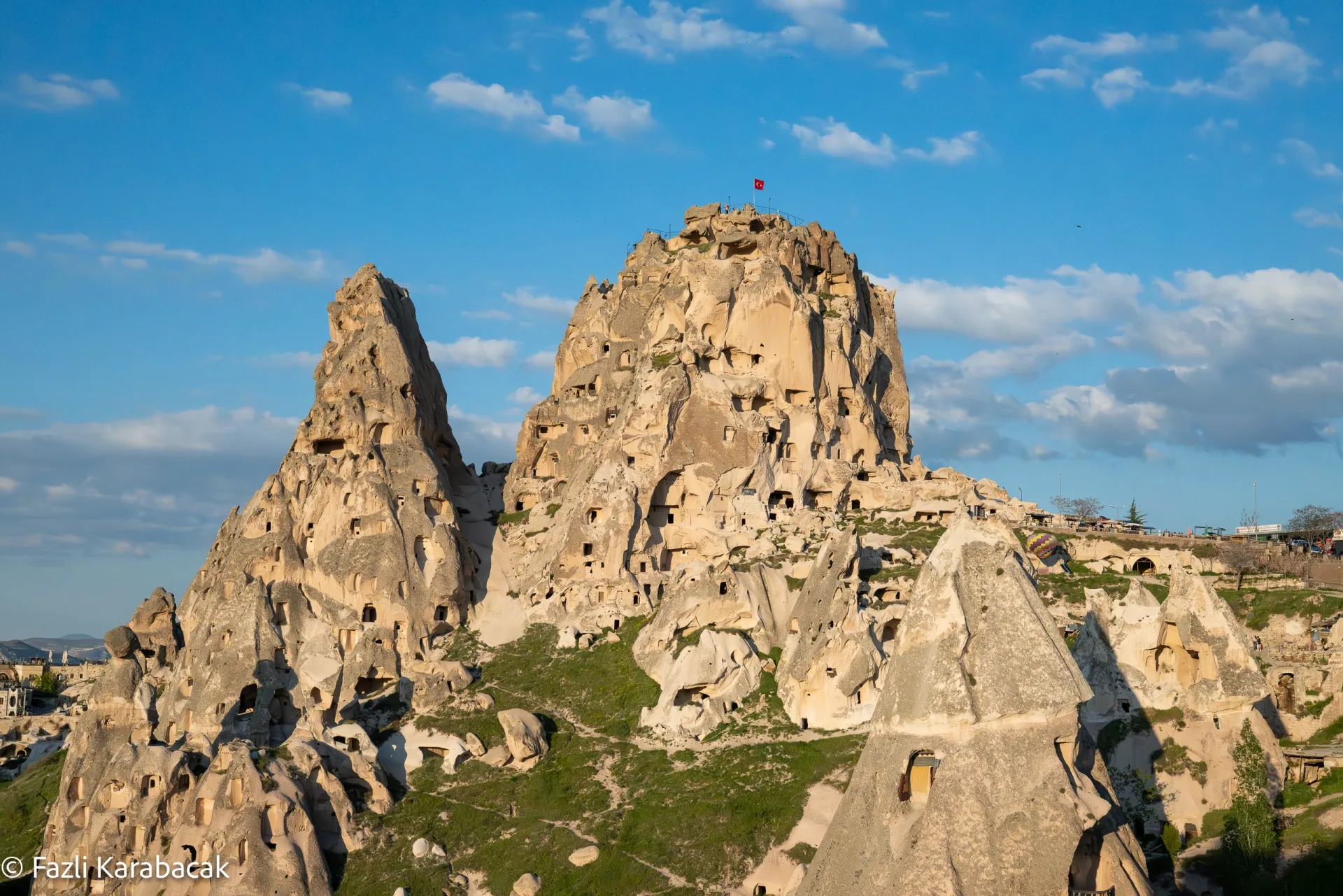
Cappadocia’s fairy chimneys are stone pillars formed over 60 million years by volcanic eruptions and erosion. Three volcanoes—Erciyes, Hasan, and Güllüdağ—deposited layers of soft tuff rock capped with harder basalt. Wind, water, and frost carved away the soft stone, leaving cone-shaped, mushroom-shaped, and columnar pillars that today reach up to 40 meters tall. You’ll find the best examples at Paşabağ (Monks Valley), Devrent (Imagination Valley), Love Valley, and the Ürgüp Three Beauties. Early Cappadocians carved homes, churches, and pigeon houses into these formations—and they’re still being eroded at roughly 1 centimeter per year.
How the Fairy Chimneys Were Formed
When I first started guiding here 25 years ago, I noticed visitors assumed these pillars were hand-carved or somehow man-made. They weren’t. What we see today is the result of geological patience on a scale that’s hard to grasp.
Three volcanic mountains created Cappadocia: Erciyes to the east (3,917 meters), Hasan to the south (2,244 meters), and Güllüdağ to the west. Between roughly 60 million and 3 million years ago, these volcanoes erupted repeatedly. Each eruption deposited layers of volcanic ash and pumice—called tuff—over the landscape. Some eruptions added flows of basalt lava, creating harder capstone layers that would later protect the pillars beneath.
The real sculptor, though, wasn’t the volcanoes. It was erosion.
Over millions of years, wind, rain, frost, and groundwater worked on these soft tuff layers. The soft volcanic rock erodes far faster than the harder basalt caps. This differential erosion is what created the fairy chimneys. Where a harder basalt layer sat atop softer tuff, a distinctive mushroom shape formed—the hat protected the pillar below. Where no cap existed, cones formed instead. In some valleys, thousands of these pillars clustered together, creating landscapes that still feel alien to me after thousands of tours.
The erosion process continues. In exposed areas, we measure roughly 1 centimeter of erosion per year. This means the tallest chimneys—some reaching 40 meters—will eventually disappear, which is why documenting and protecting them matters so much today.
The Types of Fairy Chimneys You’ll See
As you hike through Cappadocia’s valleys, you’ll notice the pillars aren’t all the same. The variation tells you something about their geological history.
Cone-shaped chimneys have no protective cap. These are older formations where the basalt layer has already eroded away or wasn’t present to begin with. They’re more vulnerable to weathering and tend to be rounder, smoother.
Mushroom or hat chimneys have a basalt cap sitting on a thinner tuff pillar. The cap shades and protects the pillar from weathering. Look closely and you’ll see the “stem” is often thinner than the “hat.” These are dramatic and photogenic—they photograph particularly well in early morning light.
Columnar chimneys are taller, more uniform pillars without distinct caps. You’ll see many of these in areas where the underlying rock layers were more uniform.
Pointed or needle chimneys are slender, almost delicate-looking formations. These are usually isolated and often the first to weather away.
In my experience, visitors are most captivated by the mushroom types. There’s something almost fantastical about them—which is probably why the Turkish name “peri bacası” (fairy chimney) stuck. The legend says fairies lived inside and climbed out through the chimneys like smoke.
Where to See the Best Fairy Chimneys
I want to give you honest locations, not just the most famous Instagram spots, though some overlap.
Paşabağ (Monks Valley) is where I take most first-time visitors. A 20-minute walk from the car park brings you to the valley’s heart. Here you’ll find some of the most distinctive chimneys, especially the famous triple-headed chimney—three pillars connected at the base or close together. The rock is softer here, so the formations are more dramatic. Bring water; there’s no shade. Morning is best for photography, before crowds arrive.
Devrent Valley locals call this the “Imagination Valley” because the formations look like animals and objects—a camel, a dolphin, a dragon. Once you notice the shapes, you can’t unsee them. The fairy chimneys here are slightly smaller but incredibly numerous. It’s less crowded than Paşabağ and wonderful for sunset photography.
Love Valley has some of the tallest mushroom-shaped chimneys in Cappadocia. The stems are thinner, the caps more pronounced. I’ve had dozens of couples propose here over the years. The valley is longer than Paşabağ—budget 45 minutes to an hour for a thorough walk. Evening light is golden and unforgiving in the best way.
Ürgüp Three Beauties (Üç Güzeller) are three distinctive chimneys standing 40 meters tall on a hillside above the town of Ürgüp. These are the most photographed chimneys in all Cappadocia. I should tell you: the Three Beauties are reinforced with steel rods and cables because of erosion and earthquake risk. This protects them, though it’s not as romantic. The viewpoint is accessible by car—no long hike required. Visit at sunrise or sunset; midday light flattens the photograph.
Çavuşin area is less touristy. The valley has excellent fairy chimneys, and you can combine a hike here with visits to the Çavuşin Old Church (one of the oldest rock churches in Cappadocia) and pigeon houses where local farmers traditionally kept birds for their guano fertilizer.
My honest advice: If you have time for only one location, visit Paşabağ. If you have a day, do Paşabağ, Devrent, and the Three Beauties. If you have two days, add Love Valley and Çavuşin.
How Humans Used the Fairy Chimneys
What fascinates me most isn’t the chimneys themselves, but what the early inhabitants did with them.
By the 8th or 9th century CE, Christians and other communities began carving into these formations. They created dwellings, storage spaces, and churches. The soft tuff was easy to carve—you could hollow out a room in days with basic tools. The basalt caps were harder but more durable, making the roofs structurally sound.
Families carved multi-room homes into single chimneys. I’ve explored some with bedrooms, kitchens, and storage cellars. The chimneys acted as natural chimneys themselves—smoke could escape through holes at the top, and the thick stone walls kept the interior cool in summer, warm in winter. Temperature inside stayed surprisingly constant year-round.
Churches were carved into larger formations or valley walls. You’ll see religious iconography in places like the Göreme Open Air Museum—visit the museum guide for more detail. Some chimneys were carved as storage for grain or as defensive structures.
Pigeon houses were carved with hundreds of small holes. Pigeons nested in these holes, and their guano was valuable fertilizer for vineyards and orchards. A single chimney might have 300 or 400 nesting holes. You can still see pigeon droppings staining the white tuff in several valleys.
This is important to understand: the fairy chimneys weren’t just beautiful geological formations. They were homes, businesses, places of worship. The landscape and human culture were woven together.
Why They’re Called “Fairy Chimneys”
The Turkish name “peri bacası” translates directly to “fairy chimney.” Local folklore says fairies—supernatural beings from Islamic and Turkish tradition—lived inside the chimneys. The chimneys were their houses, and smoke rising from the top was evidence of their fires and presence.
Whether this comes from genuine belief or poetic observation, I’m not sure. But the name caught on and spread worldwide. It’s romantic without being inaccurate—these formations do look otherworldly, and the folklore is respectful of the landscape’s power.
Erosion and Conservation
I’ll be direct: the fairy chimneys are disappearing. Not quickly, but inexorably.
The 1cm-per-year erosion rate in exposed areas is measurable. Some pillars are thinner than they were 25 years ago. Frost-wedging—water freezes in cracks and expands, shattering rock—accelerates erosion in winter. Heavy rain in spring and autumn causes significant weathering.
The Three Beauties were reinforced with steel cables in the 1990s and 2000s specifically because they were at risk of collapse. This protects them but changes their appearance. Several chimneys in Paşabağ show visible cracks and are monitored by local authorities.
There’s no way to stop erosion entirely. What we can do is limit human damage: stay on marked trails, don’t carve into formations, don’t remove rocks or samples. Every vandalized surface erodes faster because you’ve exposed fresh rock to weathering.
If you visit in 30 years, some of these iconic formations will be noticeably smaller. This is sobering, but it’s also why visiting now matters.
Best Time to Visit and Photography Tips
Spring (April–May) and autumn (September–October) offer the most comfortable temperatures—15°C to 25°C—and the clearest light.
Summer (June–August) is hot, especially at midday (30°C+), but early morning light is exceptional. Sunrise and sunset cast long shadows that emphasize the chimneys’ three-dimensional form.
Winter (November–February) brings fewer tourists and dramatic skies, though some valleys can be muddy after rain.
For photography, shoot early morning or late afternoon. The low angle of the sun creates shadow and depth that reveals the chimneys’ true form. Midday light is harsh and flattens the landscape.
Bring more water than you think you’ll need. There are no water sources in the valleys themselves. Wear sun protection—the white tuff reflects intense UV light even when temperatures are moderate. Comfortable hiking boots are essential; the ground is rocky and uneven.
For more detailed hiking information, see our guide to Cappadocia hiking trails.
Connecting Cappadocia to Deeper Geological Time
Cappadocia’s fairy chimneys are recent in geological terms. The volcanic activity that created them occurred during the Eocene to Pliocene epochs, when the supercontinent Pangaea had already broken apart and modern continents were taking shape.
To put this in perspective, the geological timeline visible at Göbekli Tepe shows that human civilization emerged only after most of these chimneys had already formed. The fairy chimneys are tens of millions of years old; human history is thousands of years old. Standing among these formations, you’re literally walking through time—surrounded by the evidence of planetary processes that occurred long before our species existed.
What to Do While You’re Here
The fairy chimneys are the centerpiece of Cappadocia’s landscape, but they’re part of a larger tapestry. While you’re visiting the valleys, consider:
- Things to do in Cappadocia — A complete guide beyond just the chimneys.
- Underground cities of Cappadocia — Descend into Derinkuyu or Kaymakli to experience where people sheltered.
- Cappadocia hot air balloon guide — See the fairy chimneys from above at sunrise.
Many visitors spend 3–4 days in Cappadocia and still feel they haven’t explored everything. The fairy chimneys are non-negotiable, but they work best as part of a broader experience.
Frequently Asked Questions
Are the fairy chimneys found only in Cappadocia? Fairy chimneys form wherever you have thick volcanic ash deposits, differential erosion, and the right climate. Similar formations exist in Turkey’s Anatolia region, parts of New Mexico, and a few other locations worldwide. But Cappadocia has the largest, most numerous, and most accessible concentration. If you want to see them, Cappadocia is where you’ll find the finest examples.
How tall are the tallest fairy chimneys? The tallest documented fairy chimneys reach approximately 40 meters (130 feet). Most are 10–25 meters tall. Size depends on the depth of the original volcanic deposits and how much erosion has already removed. The Three Beauties near Ürgüp are among the tallest and most photographed.
Can I hike through the valleys alone, or do I need a guide? Trails are marked and relatively straightforward, so solo hiking is safe. However, a guide adds immensely to your experience—they can point out details you’d miss, explain the geology clearly, identify plants and birds, and share local stories. I’m biased, but after 25 years of guiding, I can tell you the difference between seeing the chimneys and understanding them is substantial. Most guides charge 200–300 Turkish Lira per person for a group tour.
Why are some chimneys reinforced with cables? The Three Beauties and a few other formations are reinforced because they showed signs of structural weakness—cracks, tilting, or erosion that threatened collapse. Steel cables and rods stabilize them, but this is a temporary measure. Even with reinforcement, these formations will eventually erode further. The cables are visible, which some find detracts from the natural beauty. I understand both perspectives.
What’s the best time of year to photograph the fairy chimneys? Sunrise and sunset in spring (April–May) and autumn (September–October) offer the ideal combination of good light and comfortable temperatures. Winter mornings after frost or snow can be stunning but challenging to photograph in. Summer sunrises are exceptional but require very early starts. Avoid midday photography—the harsh overhead light erases the three-dimensional form that makes the chimneys remarkable.
How much erosion happens each year, and will the chimneys eventually disappear? In exposed areas, erosion rates are roughly 1 centimeter per year. This means a 40-meter chimney, if fully exposed and facing the harshest weather, would take 4,000 years to erode completely. But uneven erosion, cave-ins, and frost damage accelerate the process in some locations. Some formations visible today will be noticeably smaller in 50 years. This is why protection and preservation matter—once these chimneys are gone, they’re gone for millions of years until new volcanic activity creates new ones.
Fazli has guided visitors through Cappadocia’s valleys for over 25 years and specializes in geology, early Christian history, and sustainable tourism. When not guiding, he’s investigating rock formations, documenting erosion, and arguing passionately about the best time to visit Paşabağ.