
Quick Answer
We’ve guided over 12,000 visitors through Cappadocia’s underground cities in the past two decades. The main four—Derinkuyu (deepest at 85 meters, 8 open floors), Kaymaklı (easiest to navigate, 4 floors), Özkonak (smaller, less crowded), and Gaziemir (most remote)—were carved by hand into volcanic tuff rock and sheltered early Christians fleeing persecution. Honest truth: some passages sit at just 160 centimeters high, so claustrophobia is real. Plan 45–90 minutes per site, visit early morning to avoid crowds, and go with Derinkuyu if you only have time for one—it’s the most impressive.
Why Cappadocia’s Underground Cities Matter
I’ll be straight with you: when our guests descend those stone steps for the first time, you see the same reaction every time. Silence. Awe. The realization that human hands carved entire communities out of solid rock, eight stories down, with no power tools, no electricity, no modern equipment.
We’re talking about structures dating back to the 8th century BCE, though their use as refuge peaked between the 7th and 11th centuries when early Christians needed sanctuary from Arab raids and religious persecution. These weren’t temporary hiding spots—they were cities. Real cities, with storage rooms for grain and oil, wine cellars, stables, kitchens, and living quarters for thousands.
Derinkuyu held approximately 20,000 people at its height. Twenty thousand. Think about that. It’s the equivalent of an entire modern town, underground, surviving on ventilation shafts, collected rainwater, and careful resource management.
The volcanic tuff—that soft, porous volcanic rock from ancient eruptions—made this possible. It’s stable enough to hold structure but soft enough to carve by hand with simple iron and bronze tools. Nature gave the Cappadocians the material; necessity and ingenuity did the rest.
Derinkuyu: Go Deep or Go Home
If you’re picking just one underground city, pick Derinkuyu. We recommend it to nine out of every ten visitors who ask, and here’s why: it’s the deepest, the most developed, and honestly, the most worth your time.
We’re describing 8 open floors descending approximately 85 meters (280 feet) below ground level. The entrance passage slopes downward gradually—the Cappadocians were smart about reducing strain. You walk through rooms stacked vertically: living quarters on the upper levels, communal kitchens in the middle, wine and oil storage deeper down. The millstone doors—massive stone discs that rolled to seal passages during attacks—still sit in their original grooves.
The ventilation system astounds our engineering visitors. Vertical shafts piercing through all eight floors provided air circulation, and some of these shafts were wide enough that people could escape if the main exits were blocked. Brilliant design, born from genuine survival necessity.
What you’ll actually see:
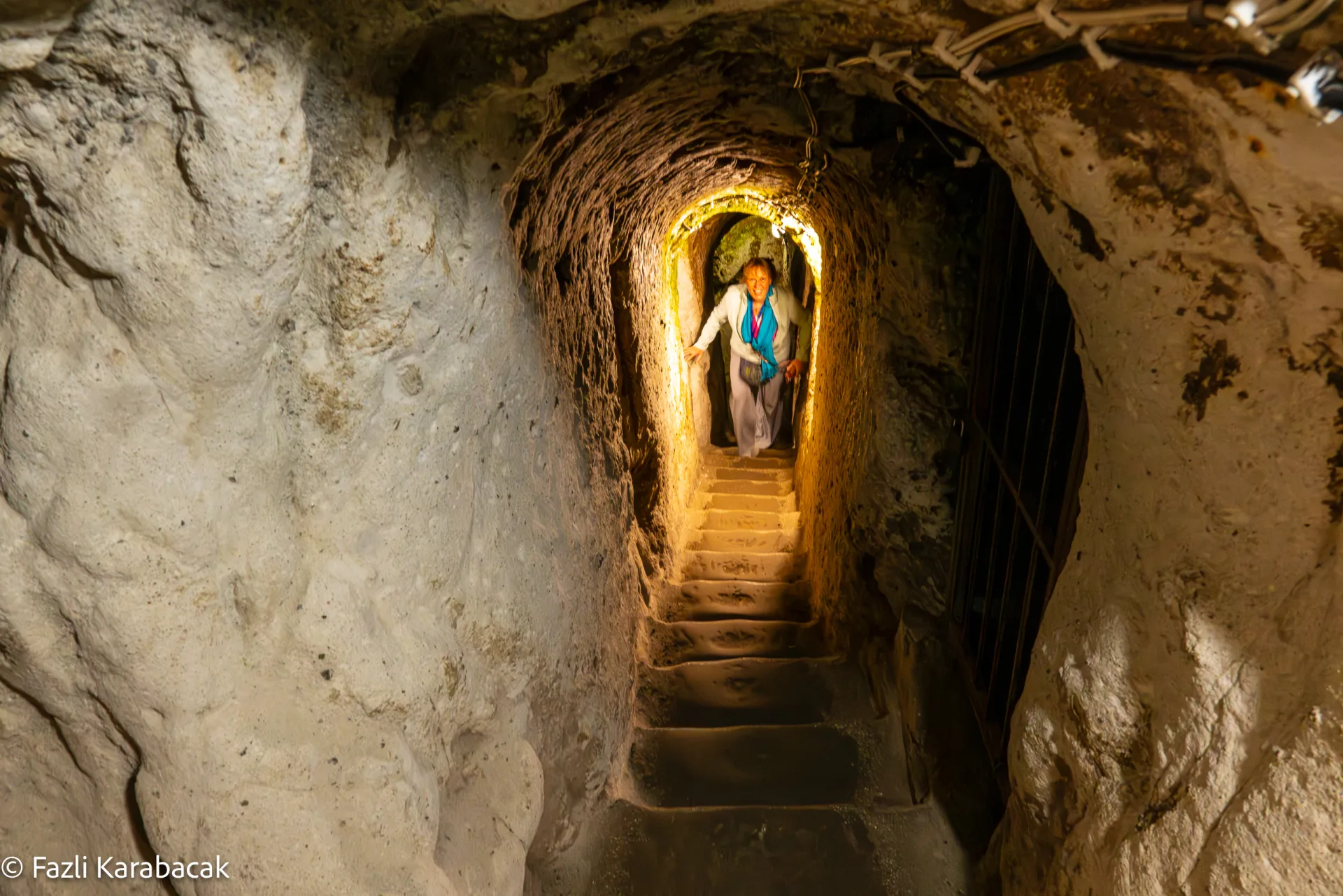
- Stone staircases worn smooth by centuries of footsteps
- Sleeping quarters with carved beds and alcoves
- The communal kitchen with hearth areas and ovens
- Wine and oil storage rooms with large carved containers
- Ventilation shafts—some narrow, some surprisingly open
- A deep well that connected to underground water sources
Time needed: 60–90 minutes if you’re moving at a comfortable pace and reading explanations. 45 minutes if you’re just walking through.
The tight-space reality: Three or four passages measure just 160 centimeters high (about 5’3”). We’ve had to guide taller visitors through on a crouch. If you’re claustrophobic or have mobility issues, these passages are genuinely difficult. Not impossible, but difficult. Plan accordingly.
Best time to visit: Arrive by 9 AM or after 4 PM. The midday crowds—between 10 AM and 3 PM—make the narrow passages feel like rush hour on the subway. Not pleasant.
Kaymaklı: Easier Navigation, Wider Passages
Kaymaklı is the second-most-visited underground city, and for good reason: it’s less vertically dramatic than Derinkuyu, but it’s wider, more comfortable to navigate, and honestly easier on the knees.
We often recommend Kaymaklı for visitors with back pain, anyone over 70, or families with children. The passages are roomier, the stairs less steep, and the overall layout feels less maze-like. You get four open floors—about 40 meters down—which is enough to feel genuinely underground without the intensity of Derinkuyu’s depth.
The city itself dates to the same era and served the same purpose: refuge and community storage. The sleeping chambers, kitchens, and storage rooms follow a similar logic to Derinkuyu, just on a smaller scale.
The main difference: Kaymaklı connects to Derinkuyu through an underground tunnel that’s roughly 8 kilometers long. This tunnel is not open to the public—we don’t recommend it even off the books. It’s partially flooded, ventilation is poor, and rescue would be complicated. We’ve had curious visitors ask us about it for 25 years. Our answer is always no.
Claustrophobia here: Much more manageable. The passages are higher, wider, and feel less oppressive than Derinkuyu’s tightest sections.
Time needed: 45–75 minutes.
Compare them: If you have time for both, great—they’re different enough to warrant both visits. If you only have time for one and you’re in average physical condition, go Derinkuyu. If you have back issues or mobility limitations, go Kaymaklı. If you have young children, go Kaymaklı.
Özkonak and Gaziemir: The Off-the-Beaten-Path Options
Not every visitor wants to join the crowds at Derinkuyu or Kaymaklı. We understand. For those travelers, we recommend Özkonak and Gaziemir.
Özkonak sits about 30 kilometers from Göreme and receives maybe 10% of Derinkuyu’s visitor traffic. It’s smaller (5 open floors, about 60 meters deep) but well-preserved. The carved pillars, the ventilation shafts, the storage rooms—all of it feels intimate, almost personal. You can imagine families actually living here, not just passing through. The archaeological detail is exceptional, and the lack of crowds means you can spend time reading the carved features without someone pushing past you.
Entry fee: approximately 250 TL (Turkish Lira) as of 2026.
Gaziemir is the quietest, the most remote, the least polished. It has 4 open floors and sits nearest to the village of Ören. We guide visitors here primarily when they ask for genuine authenticity—less reconstructed stairs, less obvious tourist infrastructure, more raw cave experience. It feels less finished than Derinkuyu because, honestly, it is. That’s also exactly why some visitors prefer it.
Entry fee: approximately 200 TL.
Our recommendation: If you have 3 days in Cappadocia and want to go deep, do Derinkuyu day one, Kaymaklı day two, and Özkonak or Gaziemir day three. You’ll see different architecture, different preservation styles, and different levels of tourism. You’ll understand underground Cappadocia in ways that visiting just one city won’t allow.
The History Behind the Cities: Early Christians and Persecuted Communities
I need to give you the honest context here because the numbers matter. Between the 7th and 11th centuries, Arab raids struck Cappadocia regularly. Byzantine emperors couldn’t provide consistent military protection. For early Christian communities—and some Muslim and Jewish communities too—going underground wasn’t a romantic choice. It was survival.
These cities provided three critical advantages:
1. Protection. Stone walls eight floors deep stopped most raiding parties. The millstone doors—some weighing up to 500 kilograms—could seal off sections. Attack a village above? The community descended, sealed the entrances, and waited it out. Invaders have a hard time sacking a city that just vanishes underground.
2. Storage. The volcanic rock’s porosity actually helped here. Wine, oil, and grain stored in underground chambers maintained consistent temperature and humidity. We’ve seen storage jars that are literally 1,200 years old, still sitting in their original alcoves. That kind of preservation doesn’t happen by accident—it’s because the underground temperature fluctuates maybe 2 or 3 degrees across the entire year. It’s naturally climate-controlled.
3. Community. These weren’t isolated bunkers. They were functional cities where families slept, worked, crafted goods, stored harvests, and raised children. Historians estimate Derinkuyu supported somewhere between 15,000 and 20,000 people at peak occupation—though probably not all at once. More likely seasonal occupation, or occupation during specific threat periods, with a core population of maybe 5,000 to 10,000 year-round.
The Cappadocians weren’t primitive. They understood ventilation, water management, structural engineering. This wasn’t desperate improvisation—it was planned architecture adapted to extraordinary circumstances.
Practical Planning: What You Need to Know
Entry fees (2026 prices):
- Derinkuyu: approximately 350 TL
- Kaymaklı: approximately 350 TL
- Özkonak: approximately 250 TL
- Gaziemir: approximately 200 TL
Turkish citizens and students get discounts. Ask at the ticket window.
Best time to visit:
- Morning hours (8:30 AM–11:00 AM): Fewest crowds, coolest temperatures, best lighting for photos.
- Late afternoon (4:30 PM–6:00 PM): Also quiet, warmer temperatures, golden light if you’re photographing exteriors.
- Avoid midday (11 AM–3 PM) unless you have no choice.
What to bring:
- Comfortable closed-toe shoes with good grip. Stone stairs are worn smooth and can be slippery, especially if you’ve got moisture in the air.
- A light jacket or sweater. Underground temperature sits around 8–12°C (46–54°F) year-round. It feels cool after you’ve been down for 30 minutes.
- A small water bottle.
- A headlamp or flashlight if you want detail photography. Official lighting helps, but it’s not theatrical.
Claustrophobia and physical limitations—honest assessment:
I’m going to be direct because I owe you honesty. If you’re severely claustrophobic, Derinkuyu will test you. The tightest passages—and there are maybe 2 or 3 sections—genuinely measure 160 centimeters high. You move through bent slightly. It’s only 20 meters of the full experience, but those 20 meters can be intense if tight spaces trigger panic.
If you have back pain, the repeated climbing matters. We’re talking about 8 floors of stairs, some steep. Kaymaklı is easier (4 floors, less steep), but it’s still climbing. If you have serious mobility limitations, you might get 15–20 minutes into either city before you realize it’s not manageable. That’s not failure—that’s learning your limits.
We’ve successfully guided visitors in wheelchairs through the upper sections of Kaymaklı (the stairs are an issue, but the ground-floor passages are navigable), but not Derinkuyu. Talk to your guide or the ticket office about your specific situation.
Which city should you pick?
Ask yourself these three questions:
- How much time do you have? (One city = 45–90 min, two cities = 3–4 hours with travel)
- Do you have any physical limitations? (Back pain, claustrophobia, mobility issues favor Kaymaklı)
- Do you prefer crowds or solitude? (Derinkuyu = busy, Özkonak/Gaziemir = quiet)
Most first-time visitors do Derinkuyu. We recommend it. But Kaymaklı is excellent if you want less physical intensity, and Özkonak deserves more visitors than it gets.
Connecting the History: Cappadocia’s Neolithic Origins
Here’s a question our archaeology students ask: what were people in this region doing before they dug underground cities?
The region’s human history is long. For context on the very ancient origins of human settlement in the Near East, check out Göbekli Tepe—the world’s oldest known temple complex, about 9,500 BCE. That’s in southeastern Turkey, not Cappadocia, but it’s the same cultural region and timeframe. By the time underground Cappadocia was thriving (8th–11th centuries), organized cave dwelling was a well-established regional practice.
Cappadocia’s fairy chimneys—those impossible stone towers—are carved from the same volcanic tuff as the underground cities. Check out our guide to fairy chimneys to understand the landscape better. It’s all one geological story.
Related Cappadocia Guides
If you’re planning a longer stay and want to connect these underground cities to your broader itinerary:
- Things to Do in Cappadocia — Full activity list beyond underground cities
- 3-Day Cappadocia Itinerary — How to structure two full days of exploration
- Göreme Open Air Museum Guide — Rock-carved Byzantine churches (also hand-carved, also stunning)
Frequently Asked Questions
Q: Are the underground cities safe? Can I get lost?
A: Yes, they’re safe. Official guides work the main sites, emergency lighting is installed, and the paths are marked. You won’t get lost in Derinkuyu because there’s really only one main route—you go down and then you come back up. Kaymaklı is a bit more maze-like on the middle floors, but still straightforward. We’ve guided thousands of people safely through both. The biggest risk is hitting your head on a low passage (wear a light hat if you’re tall) or slipping on smooth stairs (wear good shoes).
Q: How long does it take to see both Derinkuyu and Kaymaklı in one day?
A: Realistically, 4–5 hours. Derinkuyu takes 60–90 minutes, Kaymaklı takes 45–75 minutes, and you need 45 minutes for travel between them (they’re about 10 kilometers apart). That puts you leaving one site by early afternoon and finishing the other by late afternoon. Totally doable if you start early and skip a long lunch.
Q: Is a guide necessary, or can I go alone?
A: You can go alone. The paths are clear, lighting is adequate, and information plaques exist at most sites. But a good guide—especially someone who actually lives in Cappadocia—will show you details you’d miss: the ventilation system’s genius, why water collection happened in certain chambers, how the millstone doors actually worked. We’ve taken guided and unguided visitors through dozens of times. Unguided visitors see the space; guided visitors understand the space. Budget for a guide if you can. A private guide costs about 300–400 TL for a half-day and is absolutely worth it.
Q: What do I do if I start feeling claustrophobic underground?
A: Tell whoever is leading you immediately. If you’re alone, identify the nearest upward passage and take it. There’s no shame in leaving. We’ve had visitors get 15 minutes in and realize it’s not for them. That’s fine. Better to leave calm and remember the experience positively than to panic 8 floors down. If you’re with a guide, they know how to walk you back up slowly and get you fresh air quickly.
Q: Can I take photos underground? Is flash photography allowed?
A: Flash is discouraged but not always prohibited—ask at your site’s entrance. The ceilings are delicate, and repeated flash photography damages them over time. Most modern phones take excellent low-light photos without flash. Bring a headlamp or small flashlight if you want detail work. Some of the most stunning photos we’ve seen from underground Cappadocia were shot without any flash, just ambient light and a good sensor.
Q: How far underground do the deepest points go?
A: Derinkuyu bottoms out at about 85 meters (280 feet) below ground level. That’s roughly equivalent to a 25-story building buried instead of rising. It’s deep enough that you genuinely lose track of the surface. Kaymaklı reaches about 40 meters. Most visitors feel the pressure and temperature change around the 4th or 5th floor—not dangerous, just noticeable. If you have ear pressure issues or are sensitive to altitude/depth changes, take it slow and descend gradually.
Fazli has guided visitors through Cappadocia’s underground cities, fairy chimneys, and open-air museums for over 25 years. This guide reflects his honest experience and practical knowledge—no hype, just real information for real visitors.